Santec Spatial Light Modulator Solutions Guidebook
table of contents
Introduction
What is Spatial Light Modulator (SLM)?
Key Applications and Case Studies by Industry
1. Quantum technology/advanced physics
2. Laser processing and additive manufacturing
3. Biomedical Life Sciences
4. Next-generation displays and AR
5. Ultrafast spectroscopy and extreme optics
6. Communications, Data, and Computing
Choosing Spatial Light Modulator: Why LCOS?
Basic characteristics of LCOS (phase modulation)
Analog drive produces quiet light
Thorough quality control through in-house integrated production
Model comparison: How to choose the best model for your needs
Frequently asked questions
Introduction
As technology advances, the roles required of optical systems are becoming increasingly complex and diverse. To meet these demands, various optical elements and modulators are used to control light. This article focuses on Spatial Light Modulators, which are devices that control the spatial degrees of freedom of light.
Controlling light is nothing more than controlling the spatial and temporal degrees of freedom that light possesses. Light has multiple degrees of freedom, such as amplitude, frequency (wavelength), phase, and polarization, and the behavior of light is determined by the intertwining of the temporal and spatial properties of these degrees of freedom. It has long been known that the spatial properties of light can be controlled using static optical elements such as lenses, mirrors, and polarizers. With the development of device technology, elements have emerged that can "dynamically" control the spatial degrees of freedom of light. These are called Spatial Light Modulator.s This makes it possible to fully utilize the degrees of freedom of light.
Currently, Spatial Light Modulators are used in a wide range of applications, including adaptive optics in microscopes, quantum bit control in quantum computing, and process control in laser processing. This article provides an overview of the basic concepts of Spatial Light Modulator, examples of their main applications, and guidelines for selecting devices.
What is Spatial Light Modulator (SLM)?
What is a Spatial Light Modulator?
Spatial Light Modulator are optical devices that electrically control the spatial distribution of light amplitude, phase, or polarization. They are widely used in cutting-edge applications such as holography, laser beam shaping, and optical communications, and play an important role in modern optical systems.
Liquid-Crystal-on-Silicon Spatial Light Modulator
Liquid-Crystal-on-Silicon SLM (LCOS-SLM) is a type of Spatial Light Modulator that uses liquid crystal, and utilizes LCOS, a reflective liquid crystal device technology.
LCOS has a structure in which a liquid crystal layer is sealed between a silicon substrate on which a highly integrated liquid crystal drive circuit is formed and a glass substrate with transparent electrodes. Millions of pixel electrodes are formed on the silicon substrate, and an independent voltage can be applied to each pixel.
When a voltage is applied, the electric field changes the orientation of the liquid crystal molecules. Since the refractive index of liquid crystal changes depending on the orientation of the molecules, the effective optical path length of incident light as it travels back and forth through the liquid crystal layer changes. As a result, the phase of the reflected light is modulated.
In other words, the LCOS-SLM is a device that can freely control the wavefront of reflected light in two dimensions by controlling the phase of light for each pixel, which allows electronic control of diffraction phenomena such as lens action, beam deflection, diffraction pattern generation, and hologram reproduction.
Our LCOS-SLM has electrodes with over 2 million pixels formed on a silicon substrate, achieving high spatial resolution. It also allows for 10-bit (1024 gradations) phase control, making it suitable for high-precision wavefront control. It achieves phase stability of 0.003π or less, ensuring sufficient drive gradation to smoothly form continuous phase changes. Its design minimizes diffraction loss, meeting the requirements of holography, quantum manipulation, and other applications.
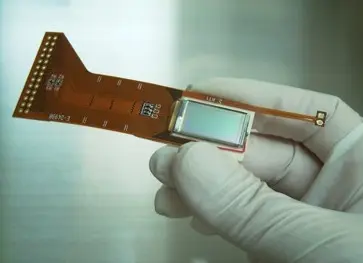
An example of an LCOS panel
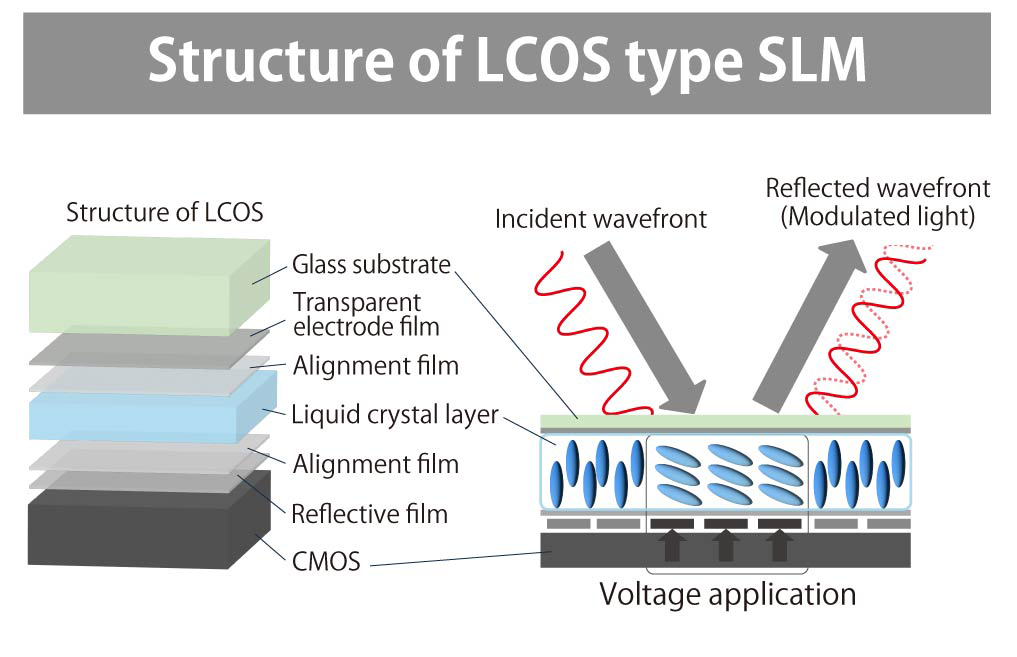
Structure of LCOS SLM
Key Applications and Case Studies by Industry
1. Quantum technology/advanced physics
In the development of quantum computer processors and quantum simulations, Spatial Light Modulator use the interference of light to create optical lattices, which can be used to arrange cooled atoms or control their quantum states.
[Core Advantage] High phase stability determines trap life
What is important in this field is to suppress minute phase fluctuations (phase flicker) of the trapped light. Fluctuations cause "heating" of atoms, shortening trap lifetimes and causing quantum decoherence. Santec 's LCOS SLM uses an analog drive system to suppress unnecessary fluctuations of liquid crystal molecules that occur with digital drive, providing "quiet light" that can stably hold atoms for long periods of time.
| Applications | Specific usage methods | Recommended Model |
|---|---|---|
| Atomic traps and optical lattices | Cold atoms are captured one by one and then arranged and manipulated as quantum bits. | SLM-200 / 210 (Phase stability) |
| Holographic Optical Tweezers | Nanoparticles and cells can be freely moved and rotated in three dimensions without contact. | SLM-200 / 210 (Phase stability) |
Major papers published
Visualizing the Fractional Orbital Angular MomentumContents: Visualization of fractional orbital angular momentum. The precise phase control of Santec SLM-200 contributes to the generation of complex optical modes.
Interactions between Fermi polarons in monolayer WS2
Contents: Elucidation of polaron interactions in monolayer materials. Stable excitation light control for measuring physical properties at ultra-low temperatures and ultra-fine scales.
Scalable Optical Control for Atomic Qubits in a Silicon Nitride Platform
Contents: In implementing high-speed quantum gates exceeding several hundred MHz, precise multi-point exposure by Santec SLM is the foundation supporting large-scale atomic control.
Scalable quantum information processing architecture using a programmable array of spin-photon interfaces
Contents: Programmable optical access to 1000 diamond spin vacancies (SnVs) is realized. High pixel-to-pixel uniformity and stability contribute to the construction of scalable quantum architectures.
Full-volume aberration-space holography
Contents: An open source software package for SLM control developed by MIT. It allows for the correction of complex spatially dependent aberrations. Santec SLM is used as a verification machine.
Quantum Airy photons
Content: Generation of quantum mechanical "Airy photons." Precise phase design using SLM enables special light shaping of quantum states.
2. Laser processing and additive manufacturing
In laser processing, Spatial Light Modulator function as optical elements that programmably shape the processing laser beam and control the processing state. By installing them in laser processing machines for welding, drilling, and cutting, as well as in metal 3D printers, they can improve processing accuracy, minimize thermal effects, and achieve efficient beam shaping, steering correction, and multi-beam control.
[Core Advantage] Beam shaping for process control and productivity improvement
In the field of precision processing, it is important to have both "light resistance" and "heat management" to ensure stable operation even under high-power laser irradiation. While resistance to high-power lasers has been an issue for conventional Spatial Light Modulator, Santec has overcome this technological barrier by developing a 1kW-compatible Spatial Light Modulator.
1kW class industrial high-power laser compatible model (SLM-310)
By precisely forming an optimized beam intensity distribution (flat top, ring shape, etc.) for the workpiece, excessive heat input is suppressed while maximizing processing efficiency. Processing control that goes beyond conventional processing methods achieves high-quality processing tailored to the workpiece and shortens processing time.
| Applications | Specific usage methods | Recommended Model |
|---|---|---|
| Industrial Laser Welding | Optimized strength distribution suppresses spatter and reduces internal voids, achieving both welding speed and quality. | SLM-310 (high lightfastness) |
| Multi-beam parallel processing | One-shot processing of multiple points improves productivity when drilling fine holes in circuit boards and panels. | SLM-310 (high lightfastness) |
| Metal 3D Printing | By optimizing the shape of the laser and controlling how heat is transferred to the metal powder, we have improved the manufacturing speed by simultaneously manufacturing multiple points. | SLM-310 (high lightfastness) |
| UV precision processing | Wavefront compensation in precision processing using UV lasers. | SLM-250 (for UV) |
| Laser heating | It can be used for laser heating, taking advantage of its high light resistance. | SLM-300 (high lightfastness) |
Major papers published
A full degree-of-freedom spatiotemporal light modulator | Nature PhotonicsContents: Combining an SLM control software package developed by MIT with Santec SLM-300 enables precise tuning of photonic crystals through optimized holograms.
Direct (3+1)D laser writing of graded-index optical elements
Contents: Direct 3D laser writing of refractive index gradient optical elements. Wavefront control including time axis by SLM-200 enables advanced microfabrication.
Rotatum of light
Content: Generation of a new dynamic mode of light, "Rotatum." The SLM-200's advanced amplitude and phase control capabilities support the discovery of new physical phenomena.
Holographic ultraviolet nanosecond laser processing using adaptive optics
Content: Application of adaptive optics (AO) in UV nanosecond laser processing. By correcting the aberration of the optical system using an SLM, the quality of micro-processing can be improved.
3. Biomedical Life Sciences
Biological tissue is like a "cloudy lens (scattering body)," and the deeper light travels, the more it scatters, resulting in a blurred image. Spatial Light Modulators correct the phase of this distorted light in the opposite direction (wavefront correction), enabling clear visualization and manipulation of living tissue at the cellular level.
[Core Advantage] Adaptive optics penetrates deep inside living organisms
The key to this field is how to cancel out the scattering of light caused by complex biological tissue. By using Spatial Light Modulator to provide a phase distribution that is opposite to the scattering, the wavefront disturbance can be restored in real time, achieving a spot diameter close to the diffraction limit even at deep tissue. Santec 's LCOS Spatial Light Modulators are highly efficient and high-resolution, allowing even weak light to reach deep tissue, enabling non-invasive observation with minimal damage to cells.
| Applications | Specific usage methods | Recommended Model |
|---|---|---|
| Two-photon microscope and depth correction | Corrects scattering of near-infrared pulses. Realizes high-speed scanning with multi-spotting. | SLM-300 / 200 (High light resistance/phase stability) |
| Optogenetics | Light is shone individually on specific nerve cells (neurons) to control their activity in real time. | SLM-200 / 210 (multi-point control and responsiveness) |
| Holographic Light Manipulation | "Light heating" and special beam generation for elucidating heat-sensitive signals within cells. | SLM-200 / 210 (multi-point control and responsiveness) |
Major papers published
Spatiotemporal temperature control by holographic heating microscopy unveils cellular thermosensitive calcium signalingContents: Elucidation of intracellular heat-sensitive calcium signals using holographic photothermal microscopy. Precise spatial heat control by SLM-100 to "heat only the targeted area."
Light needle microscopy with spatially transposed detection for axially resolved volumetric imaging
Content: Volumetric imaging using a "light needle." Special beam shaping by the SLM-100 enables high-speed observation of thick samples.
Pain induces stable, active microcircuits in the somatosensory cortex that provide a therapeutic target
Content: Visualization and control of neural circuits (microcircuits) in the brain. Multi-point stimulation and observation using the SLM-200 contributes to identifying treatment targets.
4. Next-generation displays and AR
In research into future augmented reality (AR) devices and holographic televisions that allow users to view 3D images without glasses, Spatial Light Modulator function as core devices that can freely manipulate the wavefront of light and project ideal 3D images in the air.
[Core Advantage] Linearity that reproduces an ideal wavefront
Because the phase modulation characteristics are linear, it is possible to reproduce a calculated 3D image without complex corrections, which is useful for demonstrating AR contact lenses.
| Applications | Specific usage methods | Recommended Model |
|---|---|---|
| holographic contact lenses | Contact lenses equipped with SLM, which superimposes AR information onto the outside world, creating a sense of depth. | SLM-200 (High resolution/phase stability) |
| High-efficiency holographic television | By synchronizing two SLMs and controlling the amplitude and phase of light, the goal is to achieve highly energy-efficient 3D displays. | SLM-200 (High resolution/phase stability) |
Major papers published
Holographic contact lens display that provides focusable images for eyesContent: We proposed a contact lens type holographic display. Using Santec SLM-200, we succeeded in superimposing 3D information that was aligned with the focal position of the human eye.
5. Ultrafast spectroscopy and extreme optics
Spatial Light Modulator are responsible for precise light control in experimental systems using femtosecond pulse shaping and X-ray free electron lasers.
[Core Advantage] Free control in extreme regions
This field requires control of laser pulse width and wavefront optimization to control nonlinear optical phenomena. Santec 's Spatial Light Modulators have high phase resolution and linearity, providing accurate phase modulation. This enables greater freedom of control in extreme regions that are difficult to access with conventional optics, such as X-rays, extreme ultraviolet, and terahertz light.
| Applications | Specific usage methods | Recommended Model |
|---|---|---|
| Ultrafast spectroscopy and pulse shaping | Phase and amplitude optimization of pump light | SLM-200 / 210 (broadband compatible) |
| X-ray beam control | Dynamic patterning of X-ray beams using a femtosecond laser. | SLM-200 (High resolution/phase stability) |
| High Harmonic Generation (HHG) | By irradiating the material with light optimized for the crystal structure, new quantum information and high-energy light can be efficiently extracted from the electrons inside the material. | SLM-200 (High resolution/phase stability) |
Major papers published
Dynamically patterning x-ray beam by a femtosecond optical laserContent: Dynamic control of X-ray beams using femtosecond lasers. Utilization of SLM-200 in extreme field optics.
Ultrafast impulsive Raman spectroscopy across the terahertz–fingerprint region
Contents: Ultrafast Raman spectroscopy. Highly flexible and efficient excitation light control using Santec SLM.
High-harmonic spin-orbit angular momentum generation in crystalline solids preserving multiscale dynamical symmetry
Contents: High-order harmonic generation and angular momentum control in solids. Precise design of incident light using SLM-200.
Scan-less hyperspectral dual-comb single-pixel-imaging in both amplitude and phase
Content: Hyperspectral imaging using a dual comb. Both amplitude and phase are controlled by the SLM, enabling high-speed, high-resolution imaging.
6. Communications, Data, and Computing
From switching optical networks that support the vast amounts of data in modern society to optical computing that solves power consumption issues in the age of AI, Spatial Light Modulator function as core components that control information by utilizing the spatial degree of freedom of light.
[Core Advantage] Information control through spatial modulation
Spatial mode multiplexing is one of the next-generation technologies attracting attention for expanding the bandwidth of optical communications. Spatial Light Modulator precisely imbue light with specific modes with controlled orbital angular momentum (OAM). High phase stability is an important factor in experiments to separate complex spatial modes with low error, and will strongly support proof-of-principle and high reliability of next-generation communication protocols. Furthermore, the spatial parallelism of SLMs is essential for optical computing.
| Applications | Specific usage methods | Recommended Model |
|---|---|---|
| Next-generation optical communications (SDM/OAM) | By utilizing the orbital angular momentum of light, spatial multiplexing transmission is realized, sending multiple pieces of information at the same wavelength. | SLM-200 / 300 |
| Optical Computing | AI matrix calculations are performed directly using the interference and diffraction of light. This is the core of the next-generation AI chip, dramatically reducing power consumption. | SLM-200 / 210 (multiple tones, high-speed calculation) |
| Free-space and underwater optical communications | The SLM corrects light distortion caused by atmospheric fluctuations and turbid water in real time (AO), stabilizing communication. | SLM-210 / 200 (High-speed response and correction capabilities) |
Major papers published
Orbital Angular Momentum-based Space Division Multiplexing for High-capacity Underwater Optical CommunicationsContent: Increasing the capacity of underwater optical communications using orbital angular momentum (OAM) multiplexing. Multiple optical modes are generated using an SLM, enabling spatially multiplexed transmission.
Spatial mode demultiplexing technique using angularly multiplexed volume holograms with a phase plate
Contents: Spatial multiplexing technology that accurately separates mixed spatial modes. The phase stability of Santec devices contributes to low error rates in communications.
Observation of distinct phase transitions in a nonlinear optical Ising machine
Contents: Implementation of a nonlinear optical Ising machine using SLM-100 and observation of phase transitions.
Choosing Spatial Light Modulator: Why LCOS?
There are various types of Spatial Light Modulator, each with its own advantages and disadvantages. Santec 's Spatial Light Modulator use the LCOS (Liquid Crystal on Silicon) method.
Advantages of the LCOS method
- High light utilization efficiency due to phase modulation element
-High spatial resolution allows for extremely complex spatial modulation
- Easy to control as it follows a general-purpose video communication protocol
The LCOS method offers top-class performance, particularly in terms of the degree of freedom in spatial modulation, and allows for extremely complex modulation. On the other hand, other methods may be superior in terms of response speed and light resistance. Santec 's Spatial Light Modulator offer a wide range of options to suit your application, including models with excellent response speed and kW-class light resistance that rivals other methods.
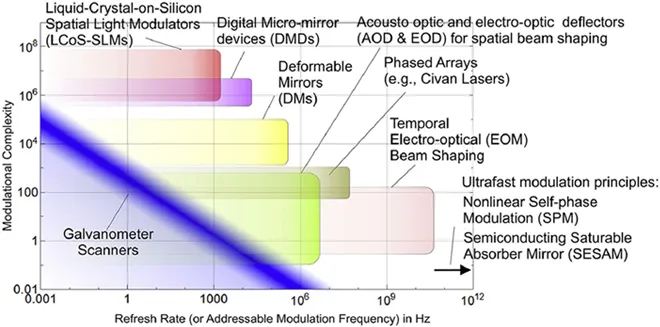
Comparison of device timescales and complexity by SLM method
Figure adapted from M. Schmidt, et al, M. Schmidt, et al, “Dynamic beam shaping – Improving laser material processing via feature synchronous energy coupling,” acturing Technology 73 (2024) 533-559.
| Device Method | LC | DM | DMD | AOD | OPA |
|---|---|---|---|---|---|
| Modulation method | phase | phase | strength | strength | Intensity/Phase |
| Typical Efficiency | 33-100% * | 33-100% * | < 6.25% * | 60-85% * | - |
| Typical Speed | < 1 kHz | 45 kHz * | > 1 kHz * | ~ 100 MHz | < 100 MHz |
| Lightfastness | Medium | Low | High | High | High |
| resolution | High | Medium | High | - | - |
| Polarization dependence | Yes | Nothing | Nothing | Yes | - |
LC, Liquid Crystal; DM, Deformable Mirror; DMM, Digital Micro-Mirror Device; AOD, Acousto-Optic Deflector; OPA, Optical Phased-Array.
* M. Schmidt, et al, “Dynamic beam shaping – Improving laser material processing via feature synchronous energy coupling,” CIRP Annals – Manufacturing Technology 73 (2024) 533-559.
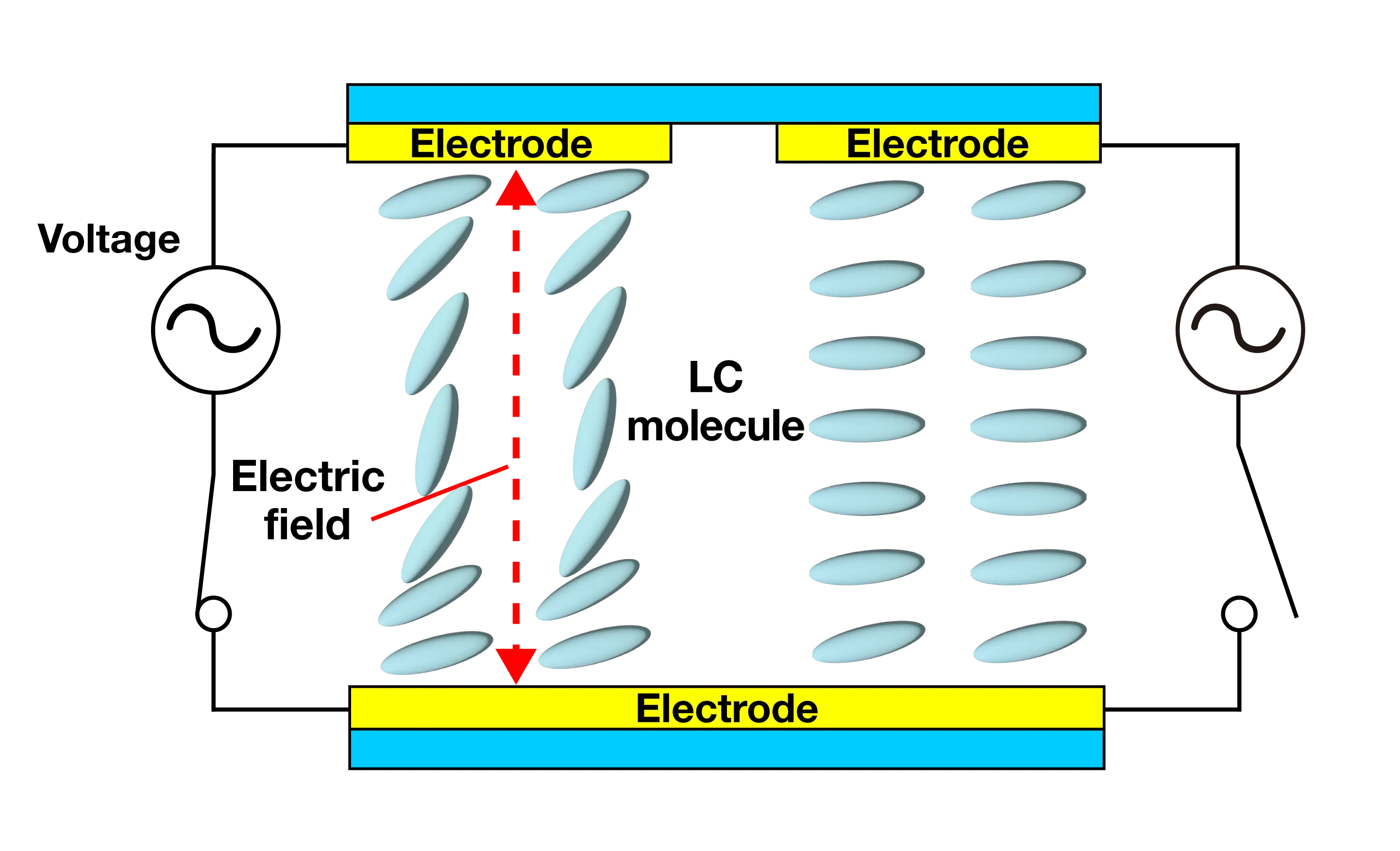
liquid crystal
Structure of LCOS SLM
Basic characteristics of LCOS (phase modulation)
Freely adjustable phase modulation amount
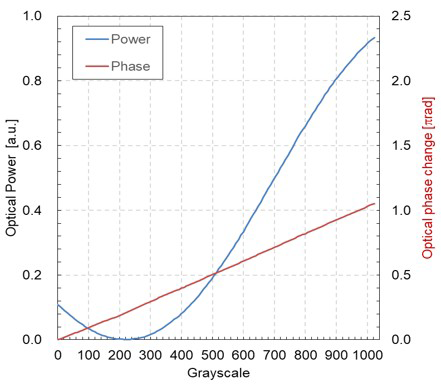
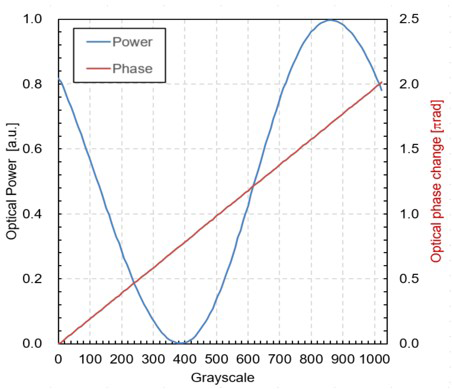
Santec 's LCOS controls the wavefront of light with nano-precision, achieving a sufficient modulation depth of up to 2πrad (1 wavelength) at the communication wavelength (1550 nm).
Flexible settings: Simply adjust the drive parameters to instantly switch to the optimal modulation range for your application.
High performance even in its raw form: Unique high-precision drive boasts excellent phase linearity.
(a)
(b)
An example of the operating characteristics of an LCOS panel (a) for π rad, (b) for 2π rad
Analog drive produces quiet light
Along with speed and resolution, stability is also important for Spatial Light Modulator. With the general digital (PWM) drive method, noise (phase flicker) caused by the constant slight movement of liquid crystal molecules due to the high-speed ON/OFF switching of voltage is unavoidable. This can be fatal noise in high-precision interferometric measurements and quantum manipulation.
Santec 's LCOS uses a unique high-precision analog drive method. By applying a constant voltage to the liquid crystal molecules, unnecessary vibrations of the liquid crystal molecules caused by the drive voltage are suppressed, resulting in quiet light with high phase stability.
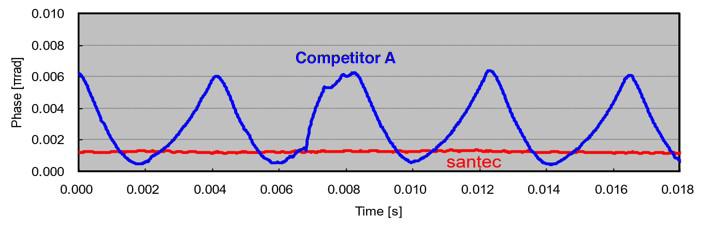
Example of phase stability characteristics of an LCOS panel
Thorough quality control through in-house integrated production
We produce the LCOS panels, the heart of our devices, in our own factory. This allows us to fully understand and manage the characteristics of each panel. For example, we are able to attach "wavefront correction data" to every product, ensuring ideal flatness from the moment the customer receives the product. We can also customize products to meet customer requests.
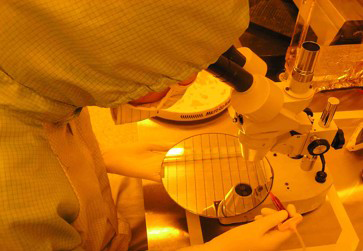
Liquid crystal element assembly line
An example of an LCOS panel
Model comparison: How to choose the best model for your needs
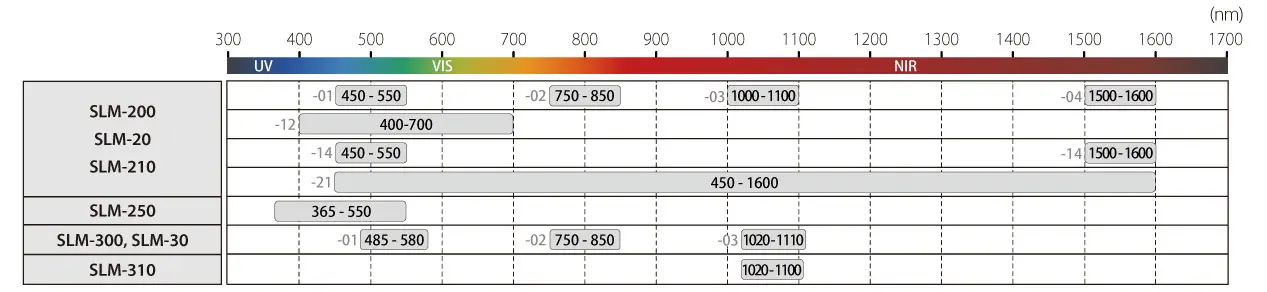
Santec offers five main product lineups to meet a wide variety of needs, such as wavelength bands, laser output, and response speed.
| series | Characteristics and Strengths | Main uses |
|---|---|---|
| SLM-310 | 1kW light resistance and high output Its unique heat dissipation structure makes it compatible with high-power industrial lasers. |
Laser welding, metal 3D printers, high-power laser applications |
| SLM-300 | High output, high resolution balanced type It combines light resistance up to 200W with high-precision wavefront control. |
Precision laser processing, two-photon microscope, atomic cooling (optical trap) |
| SLM-210 | High-speed response Our unique drive technology achieves the fastest response time in its class. |
Adaptive optics, optogenetics, optical tweezers, free-space communication |
| SLM-250 | Ultraviolet (UV) resistant Demonstrates high durability in the UV wavelength range where degradation is severe. |
UV laser microfabrication, semiconductor exposure, photolithography |
| SLM-200 | Standard model A standard product that supports a wide range of wavelengths and has excellent phase linearity and stability. |
Holography, quantum computers, adaptive optics in general |
Click here for detailed specifications of each model (reflectivity, pixel pitch, external dimensions, etc.)
FAQ
- Q1. Can I borrow a demo unit to try it out in my own experiment before purchasing?
- Yes, we offer free demo evaluation of various LCOS-SLM products. You can check in advance whether the expected performance will be achieved and whether it will work with your existing optical system and software in your actual usage environment.
- Q2. Can I control the SLM using Python or other programming languages?
- Yes, the standard "SLM SDK" enables advanced real-time control in major languages including Python (Python, MATLAB, C++, C#, LabVIEW, C). For more information, click here.
Click here for frequently asked questions.
If you have any other questions or concerns, please feel free to contact us.